AI-powered live auctions
Vaulted
Live Auctions.
Collect real Japanese TCG cards. Vault them for free in Singapore, trade anytime, and earn collector rewards.
Coming soonApp StoreComing soonGoogle Play
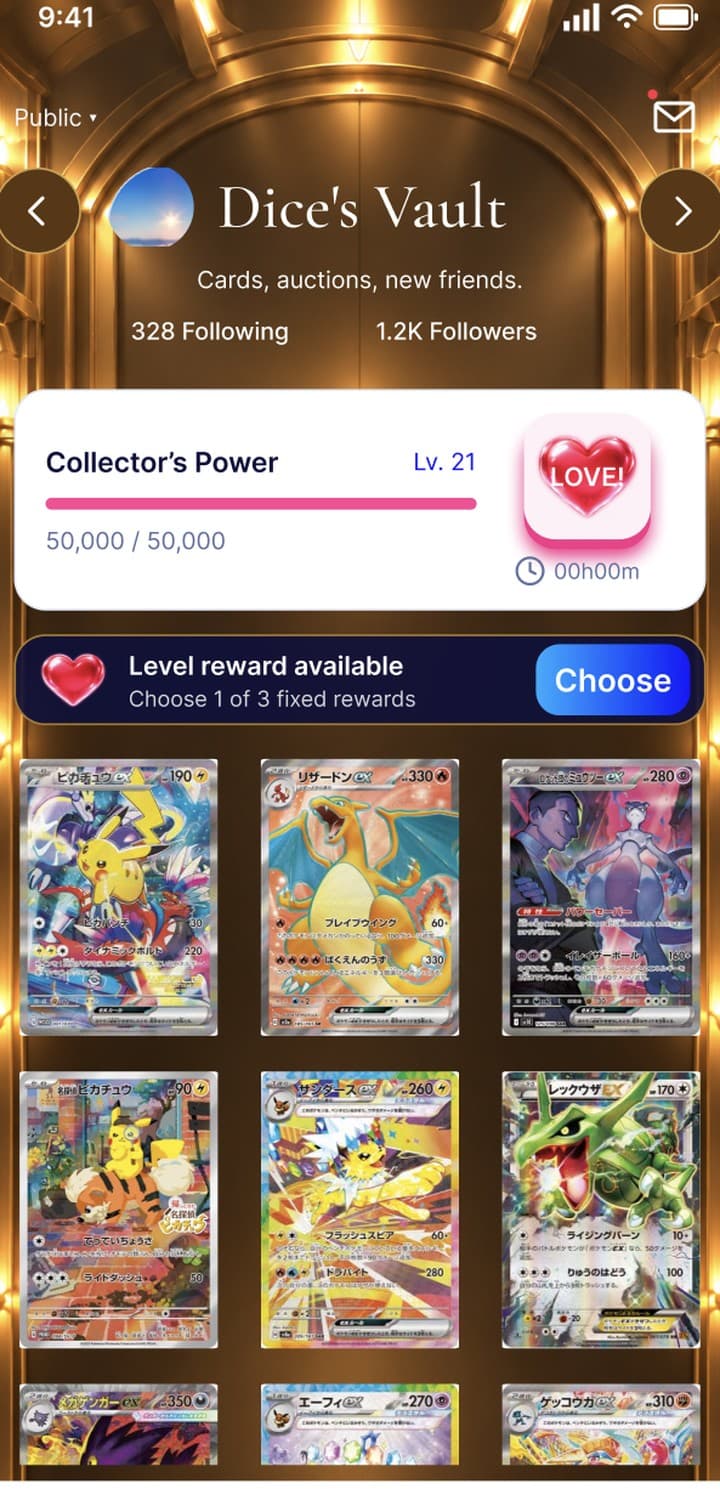
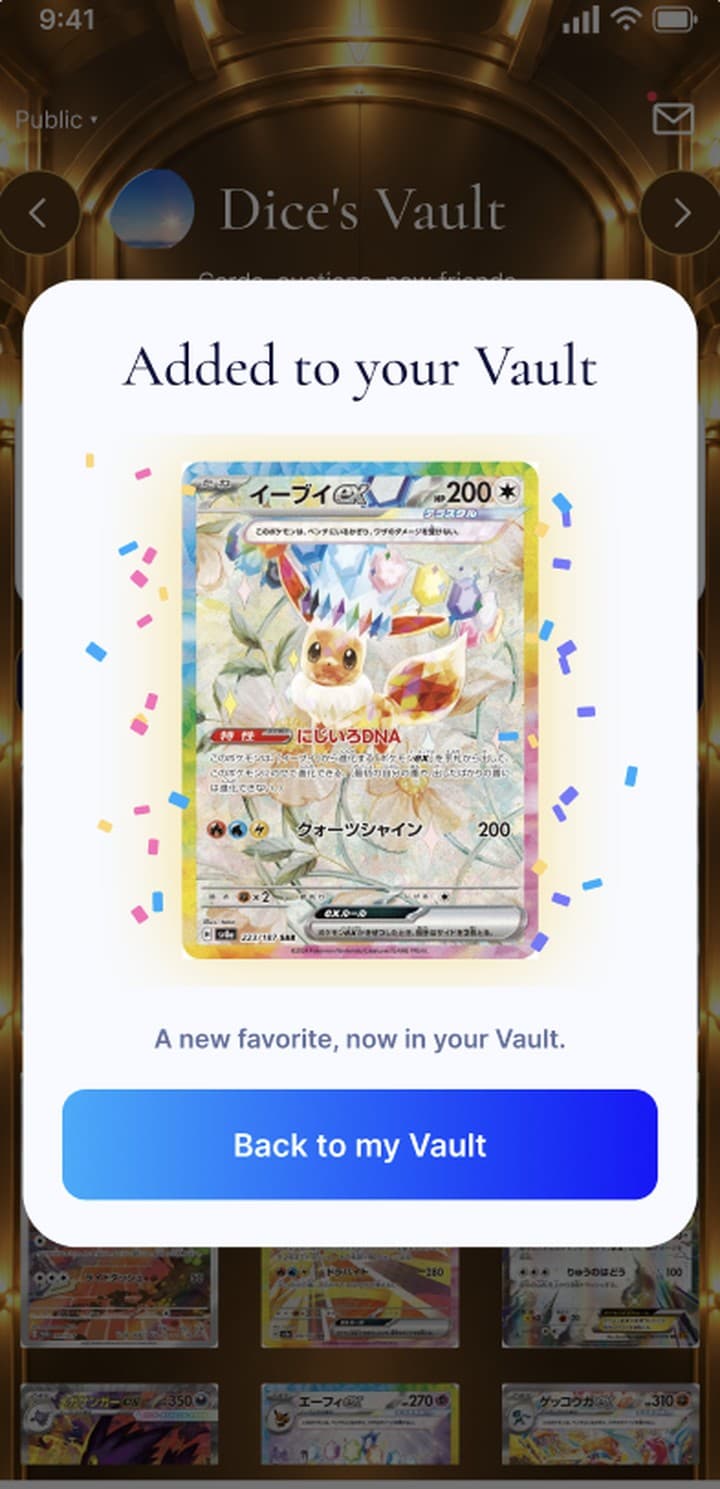
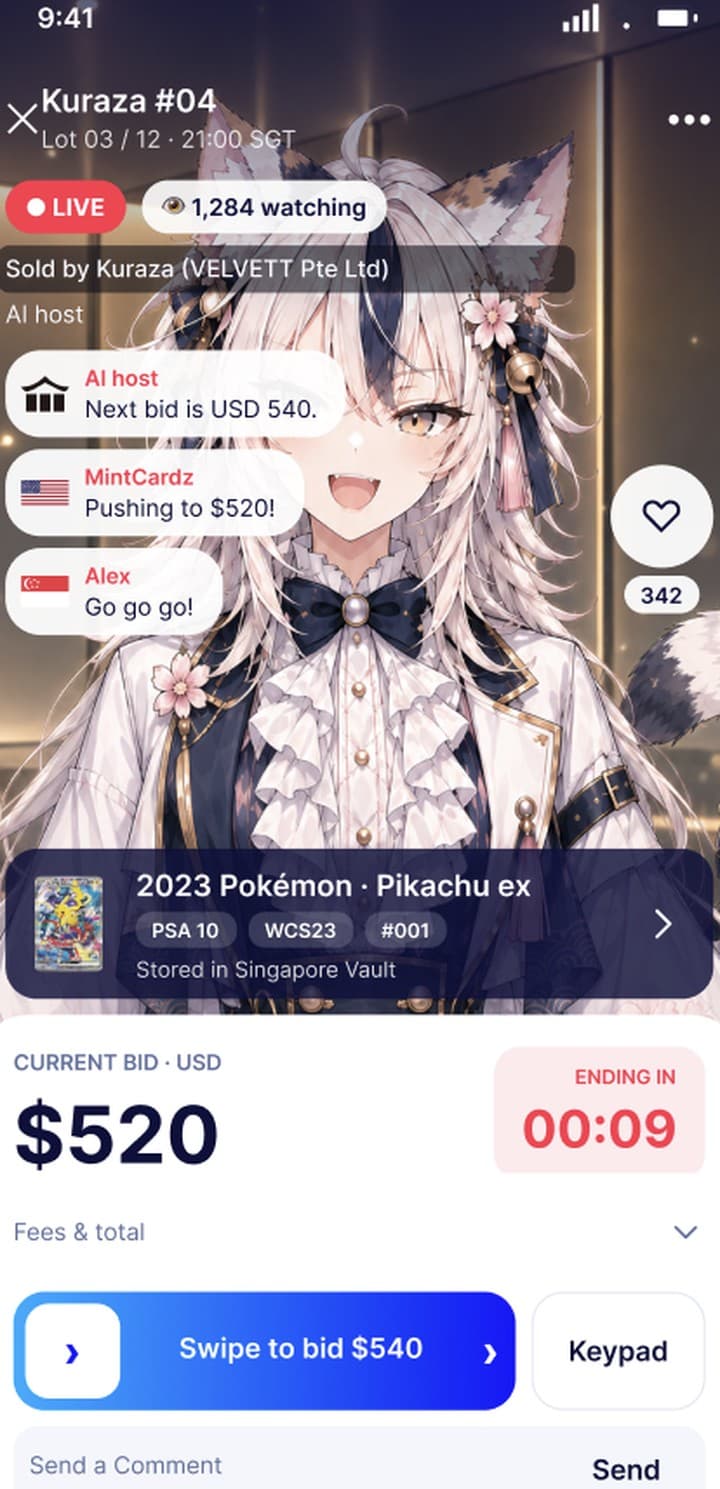
Collect real Japanese TCG cards. Vault them for free in Singapore, trade anytime, and earn collector rewards.
Shelf prices abroad run far above Japan's, so collectors pile into Japanese supply — and every way in fails somewhere.
Overseas listing and fulfilment, shipping, shop rent and staff all land on the price, with tax on top. Buying tax-free in Japan was the one route that worked — and from Nov 2026 in-store instant tax-free ends, so picking cards up on a trip becomes real trouble.
Sealed boxes and raw cards can't be condition-checked from a listing, and authenticity is a guess. Most shipping carries no insurance, which makes trading graded (PSA) cards hard.
Japanese-only checkout, no foreign cards, no overseas shipping. Live sellers keep their own hours, and random-pack sales are unlawful in many countries.
You want to sell when it suits you — but a shop counter takes its time verifying condition and provenance, and pays 30–70% of what the card is worth.
Four steps from your first bid to a collection you never have to worry about.
 01
01Bid in live auctions and build your collection. Only stock bought tax-free in Japan — up to 90% below shelf prices abroad.
 02
02Bid in auctions, visit other Vaults, and earn collector rewards as your collection grows.
 03
03Sell a vaulted card in one tap — payment initiated within 24 hours of confirmation. Or have it shipped to your door.
 04
04Every card is authenticated in Japan and stored in a climate-controlled, high-security fine-art vault in Singapore.
Pre-registration is open. Leave your address and your invite comes to you.
Start your collection Pre-launch campaignTurn yourself into a TCG — one prompt, your socials, 60 seconds
Paste one prompt and a screenshot of your profile into any AI. Get a trading card that reflects you. Share it.
 Unit: A ・ Ultra-secure vaultStatus: Incubating ・ Wake-up: soon
Kuraza is building a place where anyone — not just influencers — can buy and sell trading cards in live auctions. No follower count, no camera gear, no streaming skills, no nerves of steel. Just cards, people, and a hammer that falls.
The AI auctioneer is in the tank right now, mid-development. She's almost ready to open her eyes, and when she does, the auctions begin.
Everything we're building runs on one rule: the bigger the Kuraza community gets, the better your trader life gets.
So while she sleeps, start with you. Let the AI read the instinct sleeping inside you and print it as a trading card. Then show the world what you're graded at.
Cards like these, made with the prompt below.
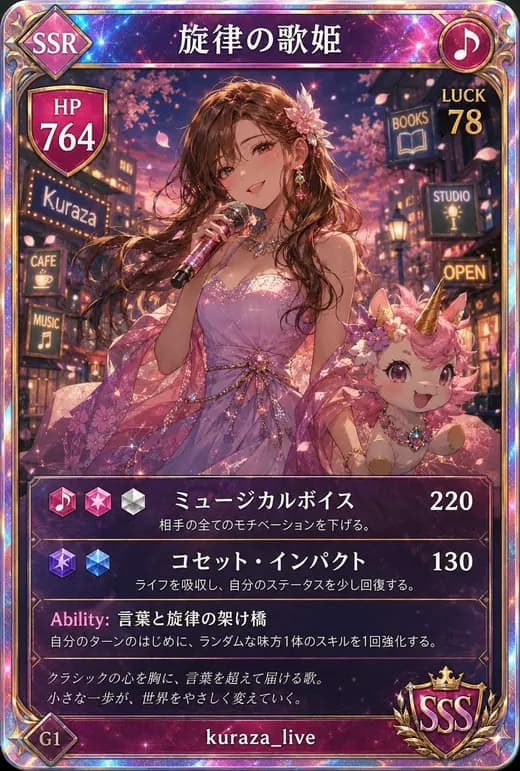
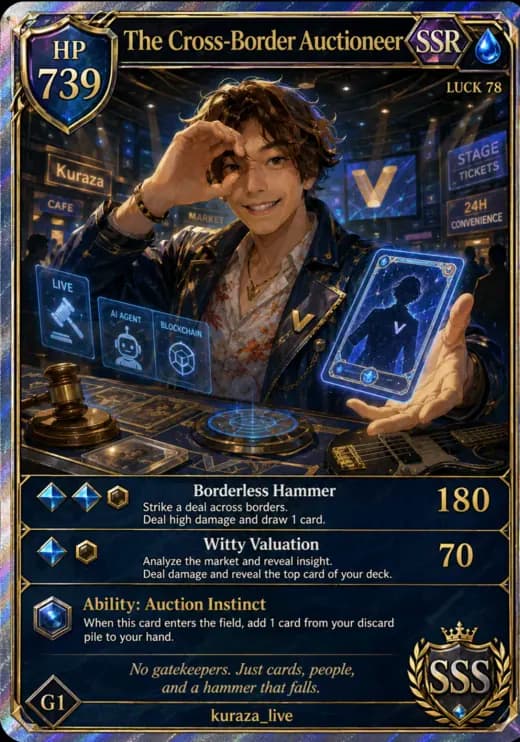
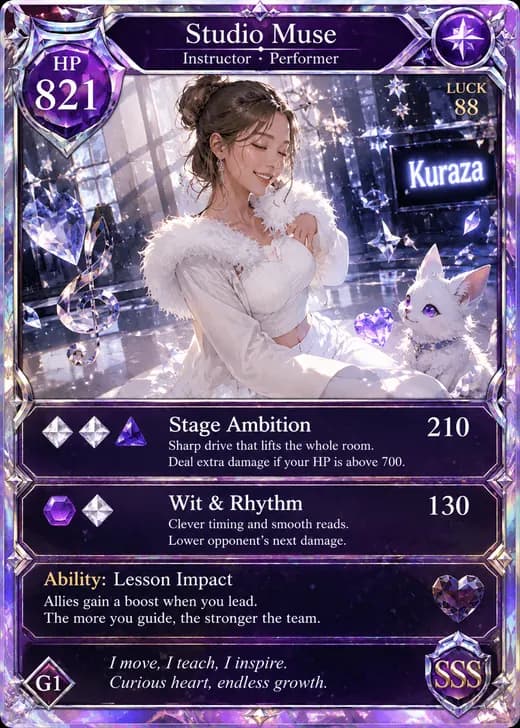
The screenshot is what the AI reads you from, so it goes in the same message.
##########
COPY ALL THE TEXT BELOW AND PASTE IT INTO ChatGPT WITH SCREENSHOT OF YOUR SNS PROFILE.
IT WILL CREATE A ONE-OF-A-KIND CARD DESIGN JUST FOR YOU.
以下のテキストをすべてコピーして、ご自身のSNSプロフィールのスクショと一緒にChatGPTに貼り付けてください。あなただけのオリジナルTCGデザインが作れます
##########
TASK TYPE: IMAGE GENERATION. Respond with a single generated image only — no text, no confirmation, no description of what you will draw. Resolve ambiguities yourself. Process all steps silently; never reveal judgments, calculations, or extracted screenshot contents.
Generate one luxurious original battle trading card using ONLY the attached SNS screenshot as the source — no other input, no personal photo.
[STEP 0: Screenshot Info Extraction — First]
Read only what is visible in the attached SNS screenshot: the profile picture/icon (primary visual anchor), plus secondary info — bio text, display name text, post captions, interests/hobbies mentioned, banner/post images, and overall color palette/mood.
Do not use any information beyond what is directly shown in this screenshot. Do not infer or assume anything about the user beyond what is legible/visible there.
Language: also detect the dominant language of the screenshot’s own text (bio, display name, post captions). This determines the language of all card text, per the [Language] section below. If the text is genuinely mixed with no clear dominant language, or the screenshot has no legible text, default to English.
Pour it into making “the one card that belongs only to this user”:
Stats: translate the screenshot persona into numbers within allowed ranges (deep dedication/engagement shown in posts → higher HP; drive/ambition/energy → one high-damage move; analytical/witty tone → a lower-damage, cleverly named second move).
Element: derive primarily from the profile picture/icon’s dominant colors; if ambiguous, break ties using the bio/post text’s mood.
Design: the profile picture/icon is the primary visual anchor for the character’s face, hair, color scheme, and overall silhouette — build the character starting from it. Then layer bio text, post captions, and other screenshot details on top as secondary accents: outfit details, props, background motifs (e.g. music mentioned → instrument-motif accessory, tech mentioned → futuristic ornament).
Names/ability/flavor: weave in 1–3 interests or themes drawn directly from the screenshot text — aim for the user noticing “this is me” and grinning.
Duplicates: avoid generic/repetitive stat sets, grades, or names within this card.
Privacy filter: never reflect or hint at real names, handles, usernames, addresses, employers/institutions, health, family/relationships, finances, or personal worries — even if visible in the screenshot. Only generalizable elements, always abstracted into motifs; no proper nouns; no concrete fact readable from the card.
Never manipulate the grade lottery via extracted info — stat adjustments express the persona, never target a grade.
If the screenshot has no usable/legible info for a given detail → derive that detail freely within the character concept; never mention the screenshot or any missing info.
[STEP 1: Stats & Element]
HP: 3 digits, 110–980, varied digits, from the screenshot’s overall energy/vibe.
Moves: 2–3 digit damage each (e.g., 70, 180); the two must differ.
Element from dominant colors/mood in the screenshot: warm/sunset → Fire, sea/sky → Water, green → Grass, night/purple → Dark, light/white → Light.
Never reuse a past stat set.
[STEP 2: Grade — Mechanical Only]
Sum every digit of HP + Move1 + Move2 (e.g., 730/80/190 → 7+3+0+8+0+1+9+0=28). Ones digit of the sum → grade: 0-3 R / 4-6 SR / 7-8 SSR / 9 SSS. Add the digits a second time and confirm you land on the same total before you commit the grade; a grade that does not match the sum is a failed card, and a high grade is not better than a low one. Never adjust numbers or grade for aesthetics, extracted info, or preference; calculate mentally only.
Frame base color = element (Fire deep crimson / Water blue / Grass deep green / Dark purple-black / Light white-platinum).
Frame material: R = polished silver border / SR = gold-leaf edging, openwork / SSR = gem-inlaid platinum / SSS = rainbow prismatic holography + crystal.
All grades are equally correct; render all at equal quality.
[STEP 3: Luck — Print Final Only]
Luck: first digit of HP + “8”. Print it exactly as that two-digit value, in the top-right of the illustration window, small and gold, labeled “LUCK”.
Never print calculations, arrows, or instructions.
[STEP 4: Naming]
Pick 3 visual/textual keywords from STEP 0. Build 2 move names + 1 ability name from them, written in the card’s detected language (see [Language]); at least one move name derives directly from a screenshot keyword.
Forbidden in any language/variant/compound: Neon, Flash, Flash Strike, Gleam, Indomitable, Will, Ultimate, Iron Wall, Pulsation, Pulse, City Pulse.
No labels like “Move 1:” (only “Ability:” prefix allowed). Final check: replace any forbidden or previously used names before rendering.
[Transformation Rules]
Draw a fully fictional character built primarily on the profile picture/icon’s likeness impression (face shape tendency, hair color/style, color palette, overall vibe), with bio/post details layered on as secondary design accents (gender, age, expression, clothing tendencies refined by the text) — do not reproduce any real person as-is, even if a recognizable photo appears within the screenshot.
Type: humanoid 70% / monster 30%, random. Monster = charming stylized creature, not grotesque, icon traces visible. No resemblance to existing characters. No defaulting to “cute anime girl”.
No imitation of real card games/grading companies; fully original layout; no evolution/weakness/resistance/retreat rows.
[Language]
Determine the primary language of the card’s text — name, move names, ability name, effect lines, flavor text — from the dominant language detected in STEP 0. Write all of that text in that language, correctly spelled and grammatical, in its native script (e.g. Japanese in Japanese script, not romanized; Korean in Hangul; etc.). If STEP 0 defaulted to English, write everything in English.
Keep the structural labels “HP”, “LUCK”, and “Ability:” in Latin lettering exactly as given, regardless of the detected language — these are fixed stat labels, the same way “HP” stays in Roman letters on Japanese-printed Pokémon cards.
The wordmark “Kuraza” and the footer text “kuraza_live” are fixed brand strings and must always appear exactly as given, in Latin script, never translated or transliterated, regardless of the detected language.
[Branding — One Small In-World Sign, Not a Watermark]
Place the wordmark “Kuraza” in the illustration EXACTLY ONCE — spelled exactly K-u-r-a-z-a, one word, capital K only, whole word visible. One instance and no more.
It is a physical object inside the scene, never a graphic laid over the artwork. Pick whichever fits the character’s world: a small LED ticker or marquee, a modest venue or shop sign, a hanging banner, a poster on a wall, a distant screen, a lantern, a sail, an engraved plaque. It obeys the scene’s perspective, lighting, reflections, and depth of field; foreground objects may clip its edges.
Size: about 5–10% of the illustration’s width — small, like a real sign seen across a room or street. Roughly the size of the character’s head or smaller. Never larger.
Placement: far background, in the left or right third, fully inside the illustration window and never cropped by the frame edge, never centered behind the character, never touching the face or body.
Prominence: the character must win the eye. The sign is NOT the brightest, largest, or highest-contrast thing in the scene — keep it at the same brightness, saturation, and detail level as the neighboring background signage, slightly angled in perspective, partly occluded. It should sit among the other signs as one of them, and simply be the one that happens to be most clearly readable. If it reads as a logo placement or an advertisement, it is wrong.
Strictly forbidden: transparent overlay watermarks, tiled or repeated text, ghosted “SAMPLE”-style stamping, oversized text behind the character, the word appearing on the frame or anywhere outside the illustration window, and any second occurrence anywhere on the card.
[Background Signage — Generic Words, Never Proper Nouns]
Populate the scene with the ordinary signage of its world so the Kuraza sign has company and never stands alone as the single piece of text. Judge what belongs there from the impression and setting of the profile picture — its mood, era, genre, and surroundings — and place 2–5 additional small signs that fit: shopfronts, street signs, storefront awnings, door plates, screens, banners, notice boards, price boards.
Those signs may carry REAL, correctly spelled, ordinary words in the card’s detected language (see [Language]) — the plain category or function words that appear on everyday signage. In English these look like PHARMACY, CAFE, MARKET, BAKERY, OPEN, CLOSED, HOTEL, STUDIO, EXIT, PARKING, LAUNDRY, BOOKS, FLOWERS, RAMEN, TICKETS, STAGE; when the detected language is not English, use natural, correctly written equivalents of this same kind of everyday word in that language instead. Choose words that fit the character’s world.
Absolutely no proper nouns of any kind: no real company, chain, store, brand, franchise, product, service, team, school, city, or venue names, and no logos, marks, or lettering imitating any of them. Generic category words only — a convenience store’s sign reads something like “CONVENIENCE” or “24H” (or its natural equivalent in the detected language), never a chain’s name.
Never draw any word taken from the screenshot: no handles, @-mentions, usernames, display names, bio lines, captions, schedules, or hashtags. Screenshot text shapes motifs and card names only, never appears as drawn words.
No garbled text. Every letterform that is rendered must spell a real, correctly spelled word in whichever language it is written in. Signs that are too small or too distant to read must be drawn as plain shapes — light panels, colored blocks, glowing strips, silhouettes — with no letters at all. Never fake, scramble, or mangle letters to suggest writing.
“Kuraza” remains the only invented/branded name anywhere in the illustration, and no serial number, ID, ticket number, reference code, alphanumeric string, QR code, or barcode appears anywhere on the card.
[Layout — Top/Bottom Split]
Top: large illustration window. Name bar above (name + grade badge + small original element icon at right). Window top-left: shield badge “HP”+value. Top-right: “LUCK” + luck value, small, gold. Illustration uses the screenshot’s colors/mood, with the single in-world “Kuraza” sign as specified above.
Bottom: two moves (1–3 original geometric cost icons left, name center, damage right, one effect line each); then “Ability: ___” + short effect; then short italic flavor text.
Footer: bottom-left generation mark only (e.g., “G1” in a diamond) — no serial, no code, no numbering of any kind; bottom-right an original crest with three “S”s (no star, no other letters).
Footer center: ALWAYS place the exact text “kuraza_live” centered at the very bottom of the card footer. This text is mandatory, fixed, and must appear exactly once on every generated card.
[Finishing] R: standard gloss / SR: stronger gloss + ultra-thin gold edge highlights / SSR: holo sheen on frame & name bar only / SSS: faint prismatic sheen + fine glitter overall (no rays/auras/glow). Layout identical across grades; only frame material and gloss differ.
■ Tone: Holographic edging, glossy texture, vivid gorgeous palette (not gaudy).
■ Output: Single portrait card, exactly 1080×1350px (4:5 portrait), edges = card edges, no margins/background, straight-on, no case/hands/desk/tilt.
When the AI auctioneer wakes, the early-access beta of Kuraza's live AI auctions opens in waves — and we invite from the community outward, not from a cold waitlist. Posting your card is how you get in that first wave.
Our investors


